
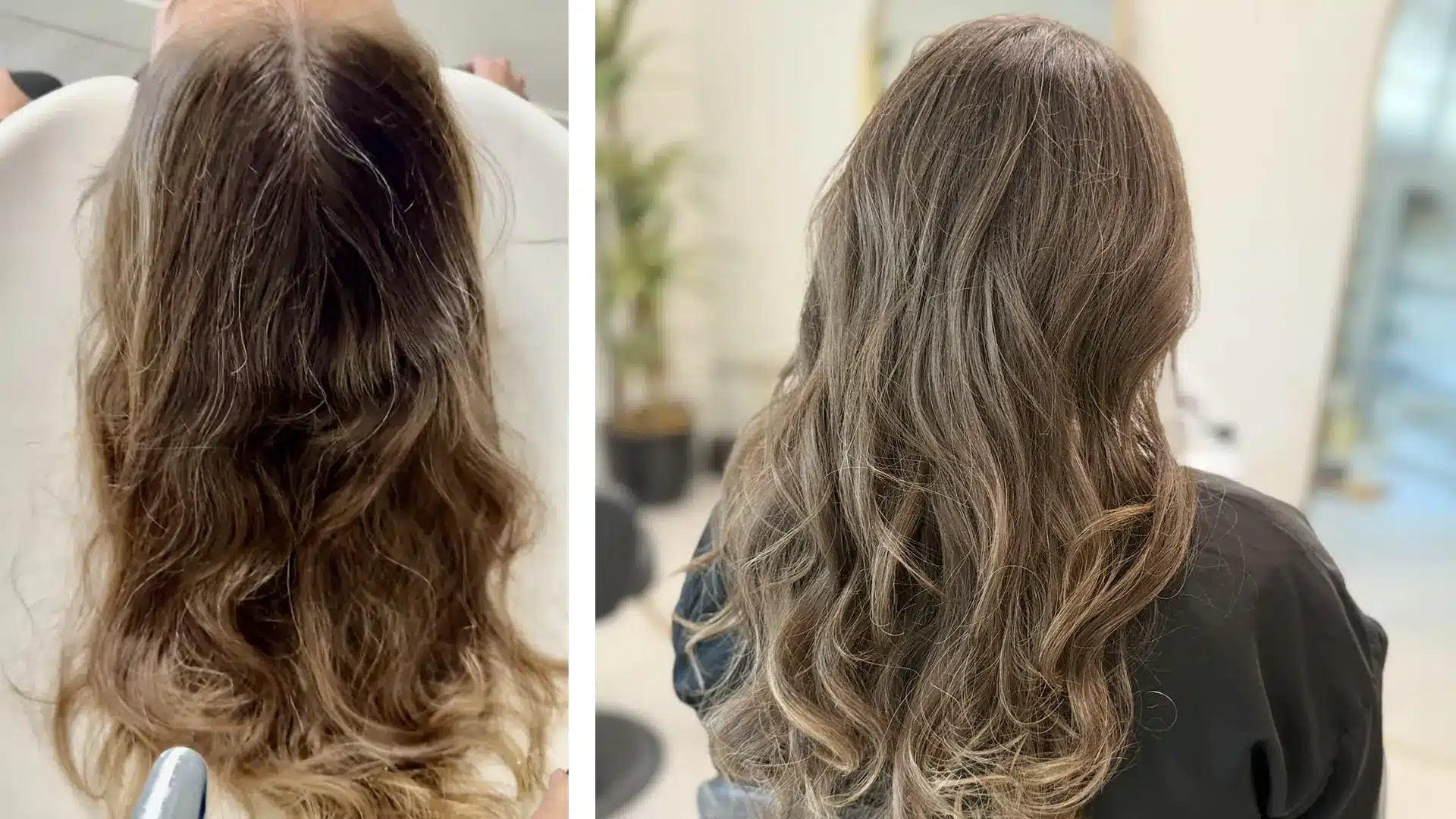
A before and after from Parlour FL — and the appointment that finally ended the every-three-weeks root touch-up.
She wasn't covering her gray anymore. She was chasing it.
Every three weeks, like an appointment she didn't quite remember making. The root spray in her bag for the days in between. The part she'd started shifting an inch to the left, because the line at her natural one had gotten hard to ignore. She didn't mind the color. She minded how much of her calendar it had quietly taken over.
“I'm not trying to look twenty-five. I just don't want to think about my roots every time I look in a mirror or book a trip.” — Client, first consultation
She wasn't asking to erase the gray. She was asking to stop scheduling her life around it.
The gray was never really the problem. The maintenance schedule was.
What is gray blending — and how is it different from covering gray?
Q: What does gray blending actually mean?
Gray blending is color designed to integrate your gray rather than paint over it. Instead of one opaque shade sitting at a single depth — the approach that draws a hard line the moment new growth comes in — blending weaves highlights, lowlights, and tone through the gray so it reads as dimension instead of regrowth. As it grows, there's no line to chase. The new gray settles into lightness that's already there.
Q: How is that different from just covering my gray?
Coverage fights the gray. It sits on top of it at one flat depth, which is the exact reason it announces itself a few weeks later — new growth against solid color is a straight line at your part, every time. Blending works with the gray instead of against it. The silver becomes part of the design rather than the thing you're racing to hide.
Does gray blend differently on dark hair?
Q: I have dark hair — is that harder?
It's the highest-contrast situation there is: silver against dark. That's why grey blending on dark hair is less about lifting everything lighter and more about breaking up the line. We place softened highlights where the gray concentrates and weave depth-restoring lowlights around them, so the eye reads movement rather than a stripe at the root. On lighter hair the grow-out is naturally more forgiving. On dark hair it comes down entirely to placement — and placement is the whole job.
Q: Isn't this just highlights?
Highlights are part of it — grey blending highlights get placed specifically where your gray comes in, so the silver reads as a lightened piece rather than a root. But highlights alone create a different problem: too much lift with no depth around it, and you've traded a gray line for a brassy one. The blend is highlights, lowlights, and tone working as one thing. Any of the three on its own is why most attempts at this end up striped instead of seamless.
The consultation: why the questions here are different
Before anything was mixed, we looked at how her gray was actually behaving — not just what color she'd asked for in previous appointments, but where the silver was coming in and how fast.
Q: What are you actually looking for?
Where your gray is, how much of it there is, how it's arriving, and what your natural base is doing underneath whatever color you're already wearing. Gray isn't uniform — for most women it shows up first and fastest at the temples and the part — so the blend gets mapped to your actual pattern, not applied as a generic technique.
Q: What did you find in her case?
Her gray was concentrated at the part and temples, and she'd been covering it at one flat depth for years. That's why she was back every three weeks — flat color has no dimension to absorb regrowth, so the second it grew, the line showed. The fix wasn't heavier coverage. It was dimension placed exactly where her gray comes in, so the grow-out finally had somewhere to go.
“She looked at how my gray was actually growing in — not just what color I wanted. No one had done that. They matched a swatch and sent me home.” — Client, post-appointment
Before and After
BEFORE
- Flat single-depth root coverage, redone every ~3 weeks
- Hard regrowth line at the part and temples
- Root touch-ups planned around her calendar
- At-home root spray between visits
- Gray reading as roots, not dimension
- Right the week of the appointment, then visibly growing out
AFTER
- Dimensional gray blending — highlights, lowlights, tone
- No hard line; the grow-out reads as movement
- Back every 8–10 weeks, on her schedule
- No interim root spray
- Gray integrated as lightness, not regrowth
- Intentional through the whole cycle
The appointment: what actually happened
Q: How did you approach the formulation?
We worked in more than one tone. Brighter pieces placed through the gray at the part and temples where it's most concentrated, softer lowlights woven underneath to rebuild the dimension flat coverage had erased. Nothing lifted to a single uniform shade. The point is contrast low enough to grow out quietly, and depth that keeps the silver reading as a highlight instead of a line.
“Nothing here is accidental.” — Deborah, Parlour FL
Q: What does all-natural professional color mean here — and does it matter for blending?
It means no harsh lifting agents, no ammonia, none of the shortcuts that trade the health of your hair for a faster result. For blending it matters more than people expect: gray hair has a different texture and porosity than the rest, and it takes tone differently. A gentler, custom formulation lets us control how the gray grabs color, so it blends evenly instead of going patchy or brassy where the silver is heaviest.
Q: What does it ask of her day to day?
Less than what she was doing. A tone-supporting shampoo once or twice a week to keep the silver clean rather than yellow — and that's most of it. No root spray. No standing three-week appointment. The work happens in the chair so her mornings don't have to carry it.
Six weeks after this photo, she realized she hadn't booked a root appointment — and hadn't needed to. That wasn't luck. That was the placement.
What this kind of color asks of her going forward
Q: How often does she actually need to come in now?
Most gray-blending clients settle into every eight to twelve weeks, depending on how fast their hair grows and how much contrast they like. Because the grow-out is built into the design, there's no urgent point where it starts to look wrong — no line forcing the appointment. She comes in when she's ready, not when her roots decide for her.
Q: The gray keeps coming in. What happens over time?
It does, and that's accounted for. As more silver arrives, the blend has room to move with it — we can lean into the gray gradually across a few appointments if that's the direction she wants, or hold the current balance. Either way it's a plan, not a scramble. Nothing about it has to happen all at once.
“We design the grow-out first. Everything else follows from that.” — Deborah, Parlour FL
Who this is for
This is for women who are tired of their gray running their calendar. Who have been covering it at a single depth and watching it show two weeks later. Who don't want to look like someone else — they want to look like themselves, without a standing appointment they plan the month around.
Gray blending at Parlour FL is custom from the placement through the tone. There is no version of it that comes from a swatch alone. The consultation is where it begins — and where most of the decisions that matter get made.
Book a color consultation at Parlour FL in West Palm Beach
Parlour FL is a color and extension studio in West Palm Beach, Florida. We specialize in all-natural professional hair color for women who expect their hair to perform — not just look right the week of the appointment.
More Related News
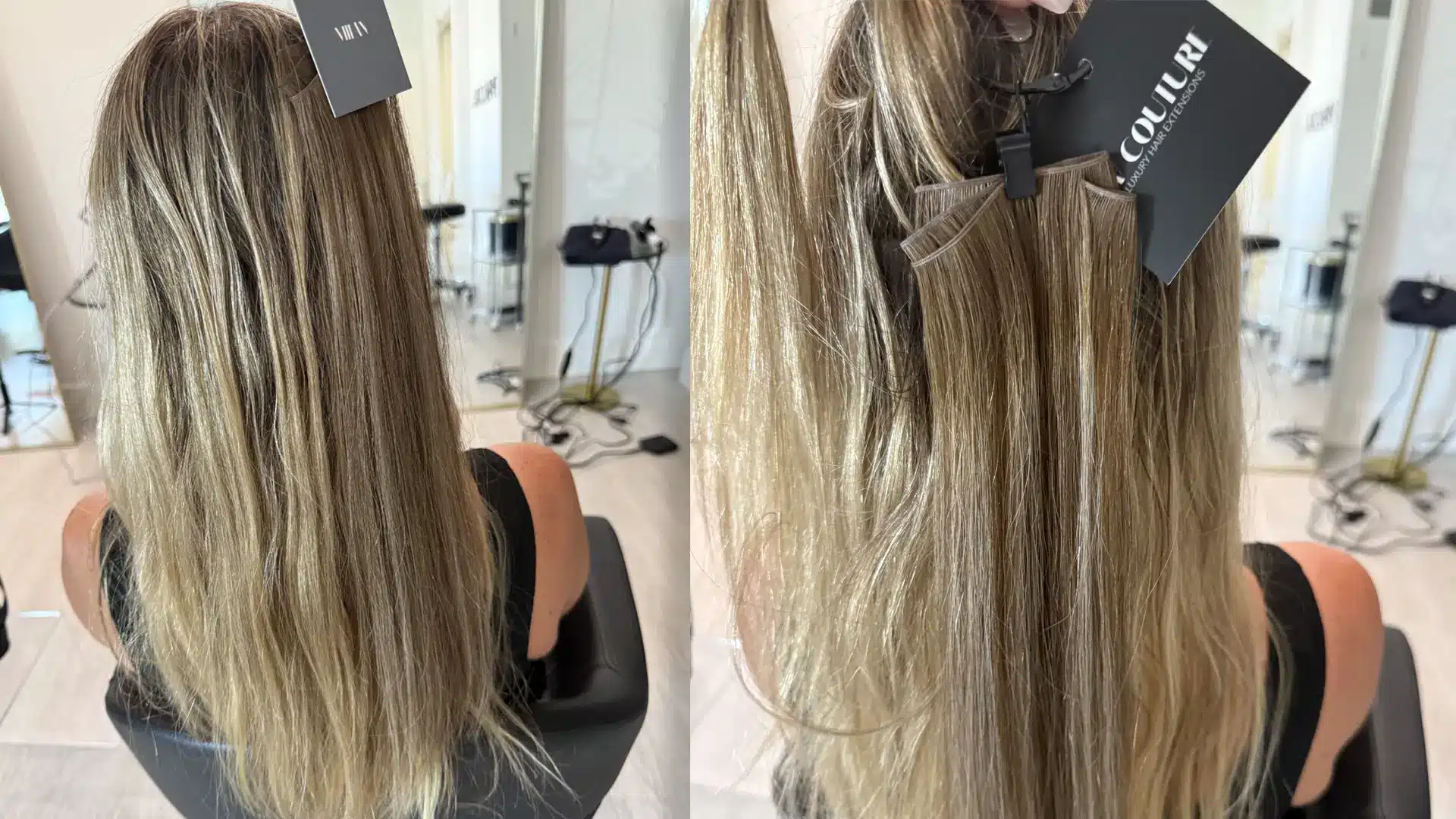
What Hair Color Actually Looks Right on You — And Why the Answer Isn’t on a Chart
Not a trend. Not a season. Not the photo you saved. A colorist's point of view on how the right color really gets decided — and why it's usually not the one you'd have picked for yourself. She brought in the photo. Everyone does — there's nothing wrong with it. But...
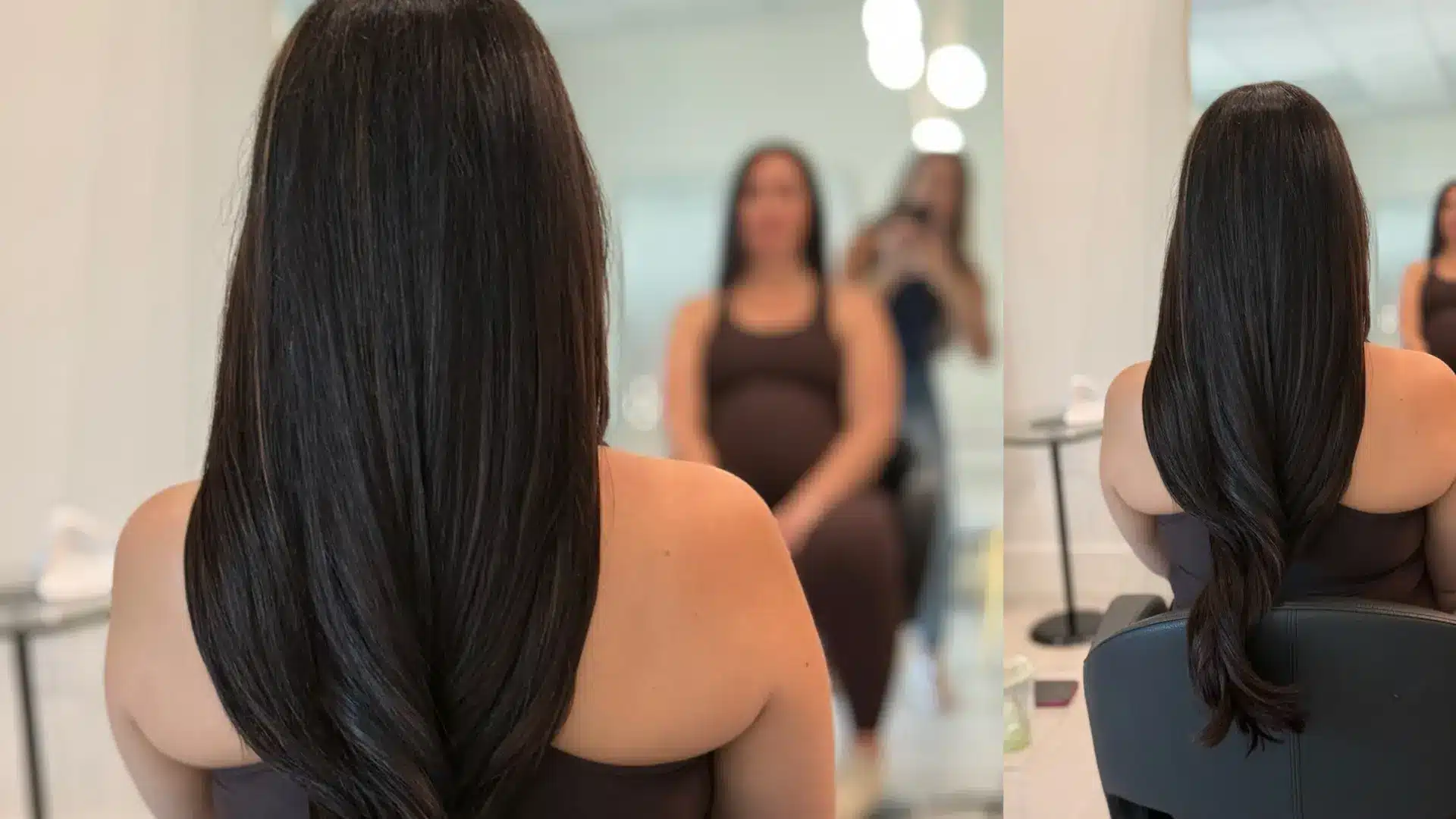
Your Hair Was Not Built for This Heat. Your Color Should Be
It's July. The light is unforgiving, the air is heavier, and your hair has opinions about both. At Parlour FL, a summer color refresh isn't about chasing a new look — it's about recalibrating for the season you're already living in. Lighter where the sun has already...

Dimensional Brunette Hair Color in West Palm Beach — Before, During, and After
What Is Dimensional Brunette Hair Color? Dimensional brunette is a multi-tonal hair color technique in which multiple shades — deeper at the base, lighter where the sun would naturally hit — are placed intentionally throughout the hair to create movement, depth, and a...